
Cosmetics and fragrance sit at an awkward intersection: the product is fragile, the price is high, and the packaging is expected to signal luxury the moment a hand touches the box. For decades that brief was met with vacuum-formed plastic, EVA foam, and flocked trays. Molded fiber now answers the same brief without the plastic — and increasingly, without the compromise.
What follows is a grounded look at what a pulp molding line can actually produce for this category, why the material fits the brief so well, and where its limits genuinely lie.

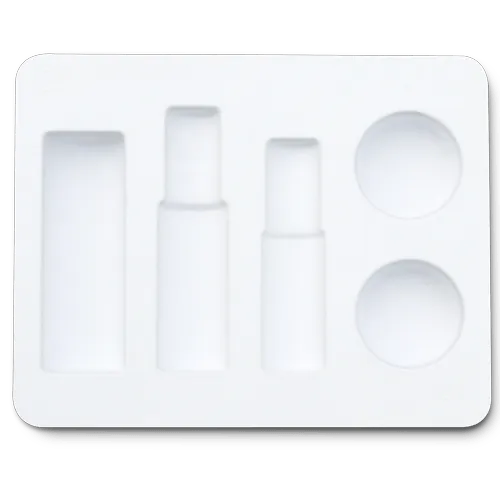
Why this category fits molded fiber so well
Most discussion of pulp molding still starts with egg trays, and that framing undersells it badly. The same forming-and-drying process that shapes a 49-cell tray can hold a perfume bottle, cradle an eyeshadow palette, or seat a serum vial — the only thing that changes is the mould. What makes cosmetics and fragrance a natural fit is not novelty; it is the overlap of three demands the material happens to satisfy at once.
- The product is fragile and high-value. A glass fragrance bottle or a pressed-powder palette punishes any packaging that lets it shift, tip, or absorb shock. Molded fiber is formed to the exact contour of the item, so it locks the product in place rather than merely surrounding it.
- The unboxing is part of the product. In this category the first impression is a sensory event, not an afterthought. A well-designed fiber insert delivers a matte, tactile, substantial surface that reads as considered rather than cheap.
- Sustainability has moved from nice-to-have to gatekeeper. Beauty and fragrance brands face tightening packaging regulation and buyers who read the box. A recyclable, biodegradable fiber insert is an easy story to tell where a plastic tray is now a liability.
That combination — protection, presentation, and a clean environmental story — is exactly where molded fiber is strongest, which is why the category has become one of its fastest-growing destinations beyond food packaging.
What a pulp molding line can produce for this category
By changing moulds, a single line can serve the whole shelf. The output falls into a handful of recurring forms.
| Product form | Typical application | What it does |
|---|---|---|
| Contoured insert / cavity tray | Perfume bottle, serum vial, single palette | Seats one item to its exact shape, prevents movement and contact |
| Divider tray | Fragrance gift set, multi-item cosmetic kit | Separates and fixes several items in one box |
| Display tray | Jewelry-grade cosmetics, prestige palettes | Doubles as the presentation surface, not just protection |
| Clamshell / lidded box | Compacts, small palettes, sample sets | The formed part is the package — no separate insert needed |
| Cushion / corner protector | Bottled or jarred products | Guards edges and necks during transit |
The pattern worth noting is that the same line moves across the entire price ladder — from a low-cost sample tray to a prestige display insert — because the process cost is driven by the mould and the finish, not by the product it happens to hold.

Protection and presentation are the same feature
In commodity packaging, protection and appearance are separate problems solved by separate layers. In cosmetics and fragrance, molded fiber collapses them into one.
A contoured cavity that holds a fragrance bottle to a fraction of a millimetre is, at the same time, the surface the buyer sees when the lid lifts. There is no gap to fill with a decorative liner, because the structural part is already the visible part. This is why the material suits the category so specifically: the feature that keeps the glass from breaking is the same feature that makes the box feel expensive.
The finish is where perceived value is won or lost. Fiber can be left as a raw, kraft-toned surface for a natural or apothecary aesthetic, or refined — smoothed, tinted, or given a soft matte face — to read as premium. The important point for a buyer is that presentation quality is a mould-and-process decision, not a material limitation. The same line that produces a plain protective tray can produce a display-grade insert; the difference lives in tooling and finishing, not in a different machine.
The cavity that protects the bottle is the surface that sells it — in this category the two jobs are one.
The sustainability story, told honestly
The environmental argument is real, but it is worth stating precisely rather than as a slogan.
Molded fiber for this category is made from cellulose fiber — commonly recycled paper stock or virgin pulp where a cleaner white or a food-safe grade is required. The finished part is recyclable in ordinary paper streams and biodegradable, which is the property that plastic and foam inserts cannot match. For a beauty or fragrance brand, that means the insert stops being the part of the pack a conscious buyer has to apologise for.
Two honest caveats keep the story credible. First, decorative coatings, laminations, or metallised finishes can compromise recyclability — the cleaner the finish, the cleaner the end-of-life claim, and there is a genuine trade-off between certain premium effects and a pure recyclability message. Second, “recyclable” and “biodegradable” describe the material’s potential, not a guarantee across every local waste system. A brand that states the fiber content plainly and avoids overclaiming ends up with a stronger position than one that leans on vague green language.
Where the limits genuinely lie
Molded fiber is not a universal replacement, and pretending otherwise erodes trust with a serious buyer. Its constraints are predictable.
- Dimensional tolerance is looser than plastic. Fiber is excellent at contoured cradling but less suited to applications needing tight snap-fits or precision mechanical engagement. Where a plastic tray clicks, a fiber tray seats.
- Very glossy, mirror-smooth surfaces are not its native register. The material’s honest strength is a matte, tactile finish. High-gloss effects are achievable through finishing but move against the grain of the material and against the recyclability story.
- Fine, sharp detail has limits. Deep undercuts, thin walls, and crisp micro-detail are harder to hold than in injection or vacuum forming. Designs that respect the material’s forming behaviour succeed; designs that fight it disappoint.
- Moisture sensitivity. Untreated fiber is a paper product. For most retail cosmetics and fragrance packaging this is a non-issue, but it is a real consideration for products with liquid exposure or long humid storage.
None of these is disqualifying for the category — they simply define the design envelope. The brands that get the best results treat molded fiber as a material with its own grammar, rather than as a drop-in substitute expected to behave like plastic.
What this means for a buyer
Read together, the picture is consistent. Cosmetics and fragrance packaging asks for protection of fragile high-value items, a presentation surface that justifies the price, and an environmental story that survives scrutiny. Molded fiber answers all three from a single process, and a single line can span the whole product range by changing moulds. Its limits are real but bounded — looser tolerances, a matte-native finish, and a respect for moisture — and they map cleanly onto design choices made before tooling rather than problems discovered after.
The most useful reframing is the one that opens this piece: a pulp molding line is not an egg-tray machine that happens to make inserts. It is a molded fiber platform, and cosmetics and fragrance is simply one of its highest-value destinations.
Common questions
Can molded fiber match the premium feel that plastic and flocked trays offer?
For this category, it often exceeds it. A matte, tactile fiber surface reads as considered and substantial, and because the insert is contoured to the product it feels bespoke rather than generic. The premium effect is a mould-and-finish decision, so the same process serves both plain and display-grade inserts.
Is molded fiber strong enough to protect a glass fragrance bottle?
Yes, when the cavity is formed to the bottle’s contour. The strength in this category comes from the fit — the fiber cradles the item to its shape and prevents movement — rather than from bulk cushioning. This is exactly the application the material is best at.
Does a decorative finish ruin the recyclability claim?
It can. Coatings, laminations, and metallised finishes move the part away from a clean paper-stream recyclability story. There is a genuine trade-off between certain premium visual effects and the strength of the environmental claim, and the honest approach is to choose which one matters more for a given product and state it plainly.
Can one line make packaging for perfume, palettes, and gift sets?
Yes. Changing the mould moves the same line between a single-bottle insert, a palette cavity, and a multi-item divider tray. The process cost is driven by tooling and finishing rather than by the specific product, which is why a single line can serve the whole shelf.
Where does molded fiber fall short for cosmetics?
Its weak spots are tight snap-fit mechanics, mirror-gloss surfaces, and very fine sharp detail — all areas where plastic still leads. It is also a paper product, so heavy moisture exposure needs consideration. For the majority of retail cosmetic and fragrance packaging, none of these is a barrier; they simply define the design envelope.
 English
  Thai
Thai  Russian
  Vietnamese