
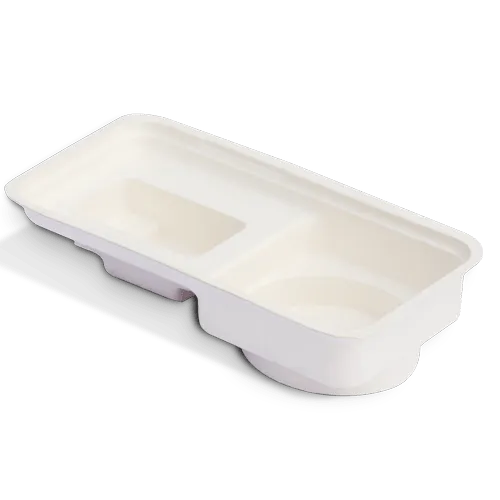
Healthcare packaging sits under a different kind of scrutiny than ordinary foodservice or industrial packaging. A kidney dish, a pill tray, a surgical instrument insert — each has to be clean, dimensionally exact, and consistent across every single unit, batch after batch. That is where molded fiber clinical packaging equipment earns its place: not as a cheaper alternative to plastic, but as the only practical way to produce single-use, compostable medical containers at hospital-supply volume.
For manufacturers moving into disposable clinical products, the machine at the centre of the line decides almost everything downstream — yield, hygiene compliance, and whether the finished pulp product can actually pass into a hospital procurement chain.
Why hospitals are moving to molded fiber
Single-use pulp containers have been part of clinical care in Northern Europe and the UK for decades — bedpans, urine bottles, wash bowls and vomit trays made from recycled fibre, used once and macerated after. The logic is simple: a disposable pulp vessel breaks the chain of cross-infection that reusable plastic carries, and it does so without adding to the plastic waste stream a hospital has to dispose of.
That established base is now widening. Pressure to cut single-use plastic, tightening infection-control protocols, and procurement targets around sustainability are pushing more health systems toward molded fibre — not only for the traditional care vessels, but for medication trays, specimen containers and protective inserts for medical devices. The demand is there. The constraint is production capacity that meets clinical specification.
What “clinical grade” actually demands from the equipment
A machine that makes egg cartons cannot simply be pointed at medical work. Clinical packaging carries requirements that reshape how the line has to be built.
Hygiene of the raw material and process. Clinical products often call for virgin pulp or tightly controlled fibre rather than mixed recovered stock, and the forming and drying environment has to keep contamination out. The product has to clear food- and medical-contact hygiene standards, which is a stricter bar than most industrial pulp work.
Dimensional precision. A medication tray with cavities that do not hold their shape, or a device insert that does not grip the product, is a reject. Clinical work leans heavily on the hot-press stage, where servo-controlled pressing delivers tight tolerances, smooth surfaces and stable geometry unit to unit.
Repeatability at volume. A hospital supply contract is not a one-off order. The line has to hold the same wall thickness, moisture level and strength across long production runs, which puts the emphasis on automated in-line control rather than manual correction.
Surface finish. Clinical containers are handled by staff and, in many cases, patients. A clean, lint-free, smooth surface is not cosmetic — loose fibre is a contamination concern. Thermoforming with heated pressing is what removes surface fuzz and gives the finished part its medical appearance.
The production sequence, step by step
A molded fiber clinical packaging line turns fibre into a finished container through a controlled sequence, and each stage has a direct effect on whether the output is clinic-ready.
- Pulping. Fibre is broken down in water into a smooth, even suspension. For clinical work the stock is cleaned and controlled more tightly than in industrial lines, since contaminants carried in here cannot be removed later.
- Forming. The suspension is drawn onto a mould under vacuum, building the wall of the container. Mould accuracy at this stage sets the baseline for every dimension that follows.
- Hot-pressing. The formed part is pressed between heated tools. This is where the product gains its final strength, its exact shape and its smooth, sealed surface — the stage that most separates clinical output from rough industrial trays.
- Trimming and finishing. Edges are cut clean and the part is brought to final specification. Precise trimming keeps edges free of loose fibre and burrs that would fail a clinical inspection.
Skip precision at any one of these stages and the whole unit is scrap — which, in a supply contract with fixed margins, is exactly what erodes profitability.
HGHY equipment for clinical molded fiber
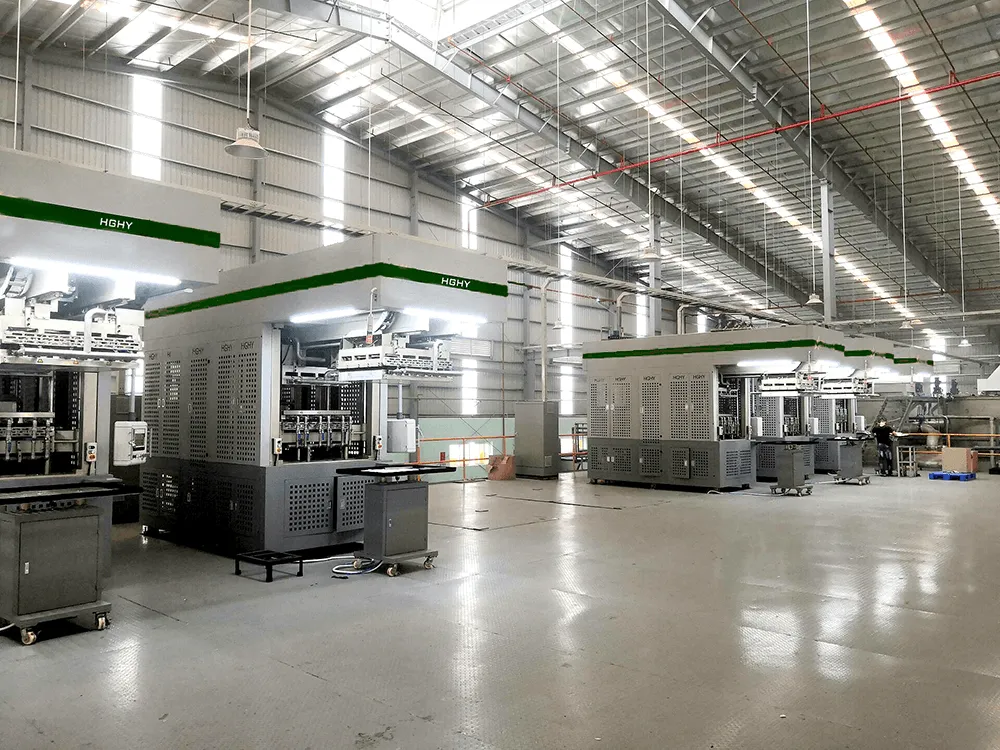
The wet-press thermoforming equipment built by HGHY is designed for precisely this class of work — turning controlled fibre stock into smooth, dimensionally exact clinical containers on a single automated platform, with reciprocating forming, servo-hydraulic hot-pressing and servo-driven trimming integrated in line.
| Parameter | Specification |
|---|---|
| Model | ZC2Q-110110 |
| Product application | Disposable tableware, paper cups, premium egg cartons, clinical containers |
| Daily capacity | 1000 kg (±10%) |
| Platen size | 1100 × 1100 mm |
| Heating energy | Electricity / thermal oil (customizable upon request) |
| Forming method | Reciprocating |
| Hot-press method / pressure | Servo hydraulic / max 60 tons pressure |
| Trimming method / pressure | Servo five-point linkage / max 80 tons pressure |
| Safety protection | Self-locking & auto-stop design |
| Max product height / thickness | 80 mm / 1.2 mm |
Several of these features map directly onto clinical requirements. The servo-hydraulic hot-press — rated to 60 tons — is what delivers the smooth, sealed, dimensionally stable surface a medical container needs. The servo five-point-linkage trimming keeps edges clean and free of loose fibre, which matters far more for a clinical part than for an industrial tray. The customizable heating lets a plant match its energy source to local cost, since drying and pressing are the heaviest running cost in molded fibre production. And the self-locking, auto-stop safety design supports the kind of continuous, controlled operation a supply contract depends on.
The same platform runs clinical containers, foodservice tableware and premium cartons, so a manufacturer can enter medical work without committing the line to a single narrow product.
What a buyer should weigh before investing
Choosing clinical packaging equipment is a longer decision than choosing a general pulp line. A few questions separate a machine that will clear hospital procurement from one that will not:
- Does the forming and pressing hold tolerance tightly enough for cavity-based medication and device trays?
- Can the hot-press deliver a surface clean and smooth enough to pass clinical inspection?
- Is the heating configuration matched to the plant’s cheapest available energy, given that drying dominates the running cost?
- How quickly can moulds be changed to move between clinical products without long downtime?
- What support, commissioning and spare-parts backing does the supplier provide once the line is installed?
A manufacturer weighing these points against a real production target is in a far stronger position than one comparing headline capacity figures alone.
Turning the specification into a quote
Clinical molded fibre is a category where the equipment decision directly determines whether the finished product can enter a hospital supply chain — and that makes supplier selection worth doing carefully. For a plant assessing this move, the sensible next step is to share the intended clinical products, target volumes and local energy conditions with the HGHY engineering team, and request a line configuration and quotation matched to that specification. A short technical conversation at this stage prevents an expensive mismatch later — and it is the fastest way to turn a production target into a working clinical line.
 English
  Thai
Thai  Russian
  Vietnamese