
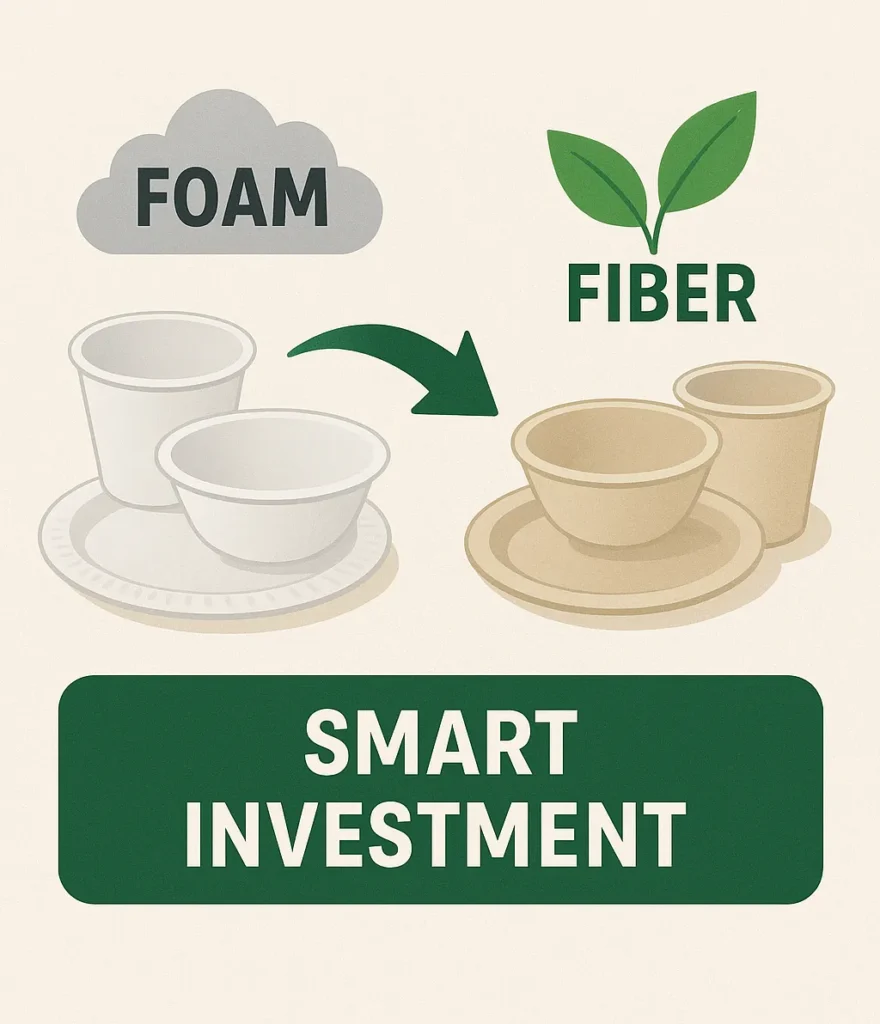
Few manufacturing opportunities line up with a regulatory tailwind, a shift in buyer behaviour and a healthy margin at the same time. The high-speed molded tableware machine is one of them. As plastic and foam foodservice ware is pushed out of market after market, the factories that can press plates, bowls and food containers from plant fibre at scale are stepping into demand that is growing faster than supply. For an investor weighing where to put capital, the question is no longer whether molded fibre tableware has a market — it is who gets the capacity in place first.
Why the timing works
The pressure on single-use plastic is no longer a future scenario. Bans and levies on plastic cutlery, foam boxes and non-recyclable packaging keep widening, and the buyers further down the chain — restaurant chains, supermarkets, food delivery brands, caterers — are rewriting their purchasing lists around compostable alternatives well ahead of the deadlines. That creates a steady, non-speculative order flow for whoever can supply fibre tableware in volume and on spec.
What makes the moment attractive is the gap between demand and capacity. Many regions still import molded fibre tableware because local high-speed production simply is not there yet. A factory that installs capacity close to its market gains on freight cost, lead time and the “locally made, plastic-free” story that buyers increasingly want to tell.
Where the money is actually made
The economics of molded tableware rest on a simple spread: the raw material is cheap and widely available, while the finished product sells as a branded, compliant, eco-friendly item. Bagasse — the fibre left over after sugarcane is pressed — and other plant pulps cost a fraction of the plastic resin they replace, and they carry none of the regulatory baggage.
Speed is what turns that spread into profit. A low-output machine makes the same product, but the fixed costs — labour, floor space, drying energy, overhead — are spread across far fewer pieces. A high-speed line changes the unit economics: more plates per hour against the same standing cost means a lower cost per piece and a shorter payback. In a market where buyers compare quotes closely, the producer with the lowest cost per compliant piece wins the contract — and capacity is what delivers that cost.
What a high-speed line brings to the table
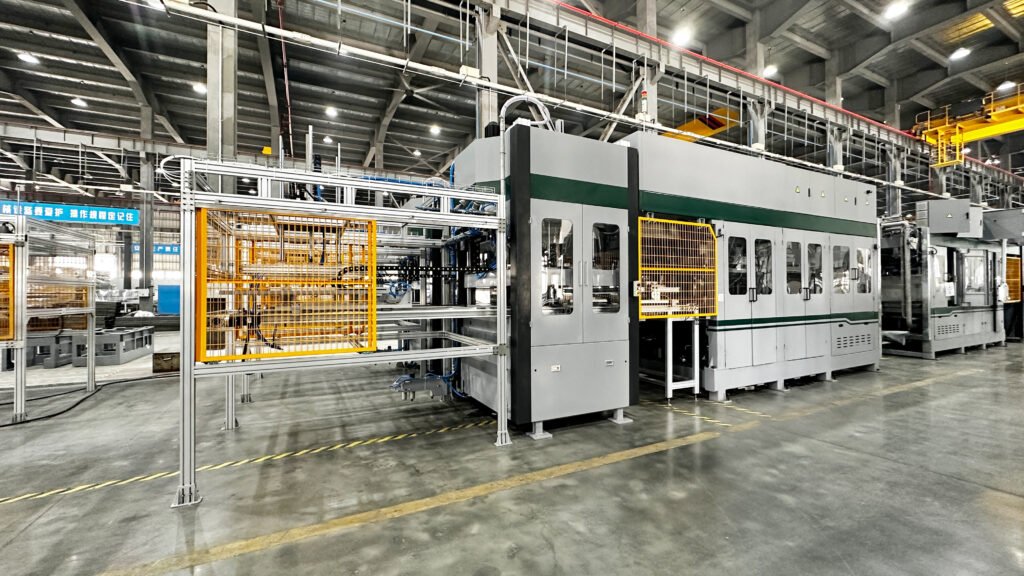
A modern high-speed molded tableware machine is not just a faster version of an old press. The jump in output comes from integrating forming, hot-pressing and trimming into one continuous, automated flow, with far less manual handling between stages. Several features matter directly to the business case:
- High throughput from one platform. A single large-platen machine presses hundreds of kilograms of finished tableware a day, so a factory reaches saleable volume without lining up a row of small machines.
- Servo-hydraulic hot-pressing. This is what gives the finished plate or box its oil and water resistance — the performance a hot, greasy meal demands — without any plastic lining, keeping the product fully compostable.
- Precision trimming. Clean, consistent edges keep waste low and reject rates down, which protects margin on items where every fraction of a cent counts.
- Flexible heating. Drying and pressing are the single largest running cost in fibre production, so the ability to match the energy source to whatever is cheapest locally has a direct effect on operating cost.
- Quick mould changes. One line can switch between plates, bowls, trays and containers by changing the mould, letting a factory follow demand across product categories instead of being locked into one item.
The equipment behind the case: HGHY ZC2Q-110110
HGHY builds wet-press thermoforming equipment designed for exactly this category of high-speed, plastic-free tableware. Its ZC2Q-110110 line illustrates what current high-speed capacity looks like in practice:
| Parameter | Specification |
|---|---|
| Model | ZC2Q-110110 |
| Product application | Disposable tableware, paper cups, premium egg cartons |
| Daily capacity | 1000 kg (±10%) |
| Platen size | 1100 × 1100 mm |
| Heating energy | Electricity / thermal oil (customizable upon request) |
| Forming method | Reciprocating |
| Hot-press method / pressure | Servo hydraulic / max 60 tons pressure |
| Trimming method / pressure | Servo five-point linkage / max 80 tons pressure |
| Safety protection | Self-locking & auto-stop design |
| Max product height / thickness | 80 mm / 1.2 mm |
The specification reads directly as a business argument. The large 1100 × 1100 mm platen and roughly one tonne of daily output put serious saleable volume within reach of a single line. The 80 mm forming height means the machine is not limited to flat plates — it can press deep bowls, lunch boxes and food containers, opening up higher-value product categories from the same investment. The servo-hydraulic press and five-point-linkage trimming hold quality and yield steady at speed, while the self-locking, auto-stop safety design keeps a high-throughput line running with fewer interruptions.
Reading the investment honestly
A high-speed line is a larger upfront commitment than an entry-level press, and that should be stated plainly. The case for it rests on three things working together: a raw material that stays cheap, a finished product that sells at a compliant-eco premium, and enough output to spread fixed costs thin. Where local demand is real and growing — which is increasingly the default as plastic bans tighten — the higher capacity is what shortens payback rather than lengthening it.
The factors worth checking before committing are straightforward: confirmed local or export demand, the delivered cost of bagasse or pulp in the region, the price and reliability of the energy that will run the dryer, and the supplier’s track record on installation, commissioning, spare parts and operator training. HGHY reports serving more than 300 clients across over 60 countries, which speaks to the installation and support experience that keeps a high-speed line productive after the sale.
The bottom line
The molded tableware market is not waiting. Plastic is being legislated out, buyers are switching ahead of the rules, and in many regions local high-speed capacity has not caught up with demand. A high-speed molded tableware machine turns a cheap, renewable raw material into a compliant, in-demand product at a cost per piece that lower-output equipment cannot match. For an investor, the opportunity is less about the technology and more about timing — and the window favours those who put capacity in place while demand is still outrunning supply.
For anyone evaluating a line, the sensible next step is to request HGHY’s full specifications, confirm which configuration fits the target market and product mix, and model the payback against local raw-material and energy costs.
 English
  Thai
Thai  Russian
  Vietnamese