
Among all molded fiber products, inner packaging for 3C digital goods is the fussiest category there is. Phones, earbuds, cameras, digital accessories — these items carry high value and demand a refined look, so the trays that hold them have to do more than just cushion against bumps. They have to make you feel, the moment you open the box, that real care went into the product. Whether paper can replace plastic blister trays and EVA foam — and pull it off in a way that’s both eco-friendly and refined — comes down to two things: how precisely the mold can be built, and whether the product comes out clean and undistorted during demolding.
These two points are exactly what separate a truly high-end pulp line from an ordinary one.
First, let’s be clear: why draft angle and corner radius are the make-or-break
Anyone who’s done molding knows you can’t get around draft angle. Once a product is formed, it has to be pulled out of the mold. If the sidewalls are perfectly vertical, the friction between fiber and mold, the vacuum suction, and the springback of the wet blank all conspire to make the part stick — at best it drags and wrinkles, at worst it tears outright and gets scrapped. So the traditional fix is to widen the wall angle: the bigger the draft, the easier the release. That’s why the product’s sides end up with that obvious “funnel” flare.
But 3C inner packaging is precisely the thing that hates a large draft. The tray has to hug the product’s contour. A phone is a boxy shape with small rounded corners, and the closer the cavity walls are to vertical, the more precise the fit — the product sits snugly without rattling, and the whole thing looks crisp and premium. Open up the draft and the fit loosens, the walls slump, and that cheap feel shows up instantly.
Corner radius works the same way. The smaller the R at a corner, the sharper and cleaner the product’s edge lines; a large R makes everything look puffy and round, and any sense of refinement goes out the window. But a small R also means that during forming, the fiber has to pack, dewater, and set inside a very tight corner — one slip and you get short shots or delamination.
So the challenge of high-end inner packaging really boils down to one sentence: you need small draft and small radius to make the shape crisp, while still guaranteeing the part releases cleanly without scrap. That’s an inherent contradiction, and ordinary equipment with ordinary molds simply can’t keep it in check.
The precision HGHY can hit: draft angle ≥0.5°, corner radius ≥0.3mm
HGHY’s high-end packaging line has been dedicated to pulp thermoforming since 2002, aimed squarely at refined inner trays and premium outer packaging. By now, its forming capability speaks for itself: it supports forming at a draft angle ≥0.5° and a corner radius ≥0.3mm.
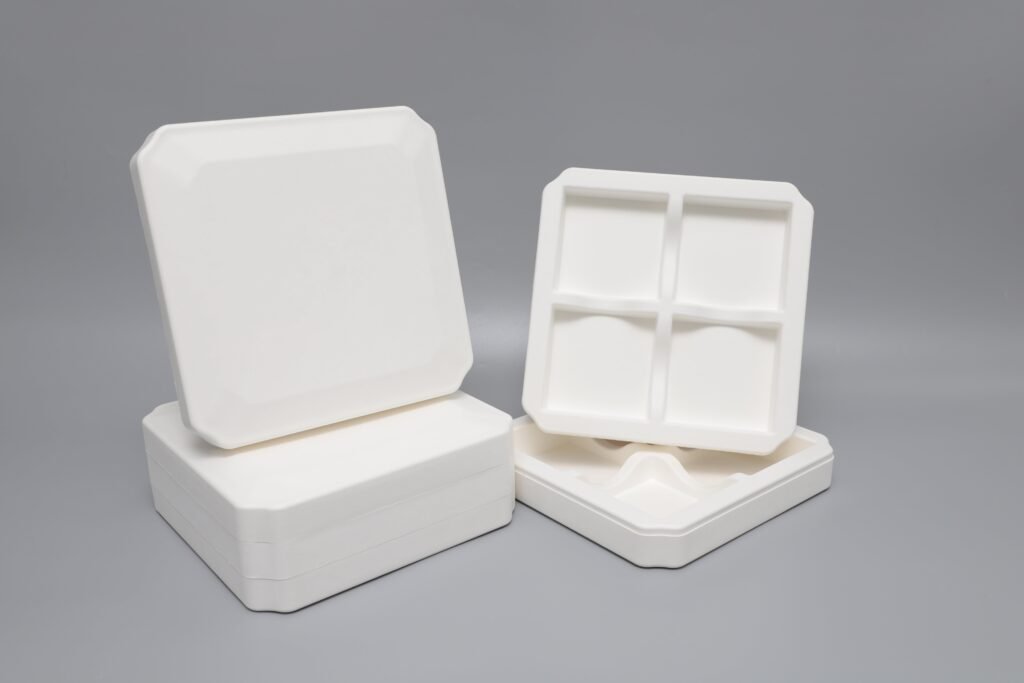
What does that number mean within the molded fiber industry? Ordinary egg trays and tableware run drafts of a dozen-plus degrees and corner radii of several millimeters — not even in the same league. A draft angle of 0.5° is already very close to a vertical wall; the sidewalls essentially “stand up,” so the fit can be made highly precise. A corner radius of 0.3mm produces crisp, fine edge lines at the corners — exactly the kind of hard, clean geometry that phone trays and accessory trays rely on.
Going a step further, when paired with a prepress device for negative-angle processing, this line can push the draft angle down to near 0° and use a small R0.3 corner for IP (inner packaging). In other words, the sidewalls can run perfectly straight up and down — even with slight undercut structures — and still demold without tearing. That’s a fairly rare capability in pulp molding, achieved through the combination of reciprocating forming plus prepress, rather than “cheating” by simply widening the draft.
For 3C brands looking to replace plastic inner trays with paper, this precision range essentially puts to rest the worry that “paper can’t achieve that plastic-like crispness.”
How that precision is pressed out: both the equipment and the mold have to be solid
Specs alone mean nothing — you have to look at how they’re achieved. Precision is never a single breakthrough; it’s the result of the equipment and the mold both holding up their end.
On the equipment side: reciprocating forming + servo hydraulics + prepress negative angle
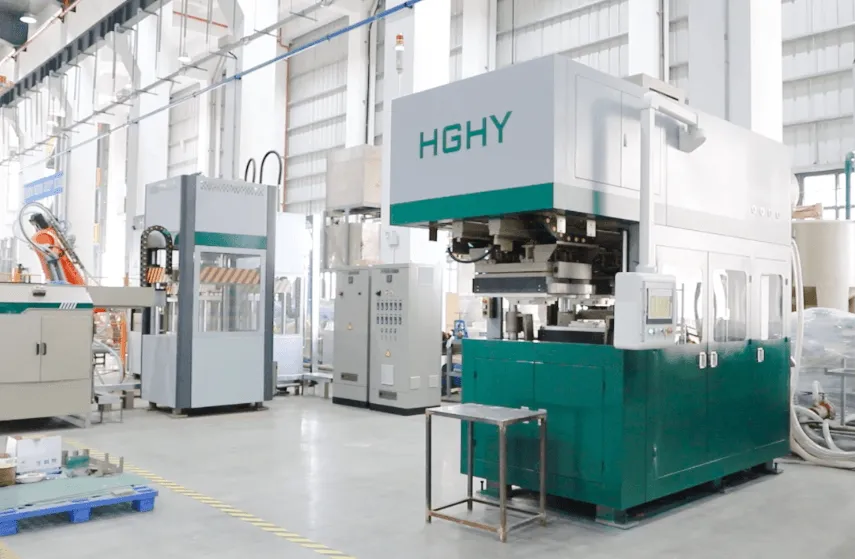
The high-end packaging machine (Series I, model ZJWD-9575) runs on reciprocating technology, with forming and hot pressing built into a single integrated design. Once the wet blank is formed, it goes straight to the hot-press station for secondary forming and drying, and position, pressure, and temperature can all be precisely adjusted — which matters enormously for small drafts and small radii. Packing out a corner and setting the walls depends entirely on dialing in pressure and temperature just right. It uses servo hydraulics with a max pressure of 30 tons, a platen size of 950×750mm, a max product height of 115mm and thickness of 1.2mm, and depending on the product, daily output can reach 650 to 800 kilograms.
The quick mold-change system is a highlight of this line. It was designed from the ground up for molded fiber packaging with small draft angles, and its built-in prepress device enables negative-angle processing, so complex structures and inner trays with undercuts can be produced too. The whole setup pairs full-automatic PLC control with servo-motor drive, and dual hot-press stations work in sync — efficiency and consistency are both taken care of.
For scenarios like new-product development, sampling, and small-batch customization, there’s also Series II (model ZJFD-7050 flip-type / ZJWD-7050 reciprocating) to choose from. It has a double-deck structure, a small mold footprint, and fast mold changes; the mold size is 700×500mm, max pressure 20 tons, max product height 120mm and thickness 1.2mm — well suited to quickly validating molds and products during the R&D stage and boosting efficiency during trial production.
On the mold side: full-chain precision from design to polishing
At the end of the day, the precision ceiling of a molded product is set by the mold. If the mold isn’t built accurately, even the best equipment can’t press out crisp edge lines and a precise fit.
HGHY has been making pulp molding molds specifically since 1996 — that kind of accumulation doesn’t happen overnight. It now uses CAD/CAM computer-aided design, paired with CNC full-automatic machining, plus fine surface polishing. Polishing is especially important for demolding: the smoother the mold face, the less friction between fiber and mold, so parts release smoothly and cleanly even at small drafts, and the product surface comes out glossy.
In terms of materials, molds can be made from ABS, aluminum, copper, steel, stainless steel, and more as needed. On the inspection side there’s CNC equipment, laser cutters, and 3D scanners, with a full system covering small trials, pilot runs, and sampling. To date, over a thousand types of molds have been developed, including inner trays for 3C categories like phones, computers, and cameras. Molds are further split into dry-press and wet-press processes, matched to different product structures and precision requirements.
In short, the mold side — from design and machining to inspection and polishing — is controlled end to end in-house. That’s the real reason small drafts and small radii can be produced stably and repeatably, rather than hit upon by luck now and then.
What this means for 3C brands
Put it all together and it’s clear: when you want to make premium 3C inner packaging with molded fiber, the real question to put to a supplier isn’t “can you make a paper tray,” but “can you produce small draft and small radius stably, and can you run it in volume without scrap.”
HGHY’s answer here is concrete: draft angle ≥0.5° and corner radius ≥0.3mm as standard, and under prepress negative-angle conditions, approaching 0° draft with R0.3 for inner packaging. The equipment uses reciprocating integrated forming with servo hydraulics for precise pressure and temperature control, while the molds rely on nearly three decades of accumulated CAD/CAM, CNC machining, and surface polishing to hold precision. The raw materials are renewable plant fibers like bagasse, wheat straw, reed, and bamboo, so the eco-friendly baseline holds too.
For 3C brands chasing both a premium feel and a sustainable path, this is essentially a viable route for turning “paper replacing plastic inner trays” from an idea into volume production — crispness, refinement, and environmental responsibility, no longer an either-or choice.
 English
 Thai
 Russian
 Vietnamese