
An automatic fiber tableware forming machine is industrial equipment that converts a water-based slurry of natural or recycled plant fibers into biodegradable disposable tableware — including plates, bowls, clamshell boxes, food trays, and cups — through a fully automated sequence of vacuum forming, hot pressing, trimming, and stacking. Unlike traditional plastic tableware manufacturing, the entire process uses no petroleum-based materials: raw inputs are sugarcane bagasse, bamboo, recycled paper, wheat straw, or wood pulp, and the finished products are compostable and biodegradable.
As governments worldwide accelerate single-use plastic bans and food service operators face mounting pressure to switch to sustainable alternatives, the automatic fiber tableware forming machine has become the core production technology behind one of the fastest-growing segments in sustainable packaging. This guide explains what the machine does, how it works, what it costs, and why investors and sustainability professionals are paying close attention to the sector.
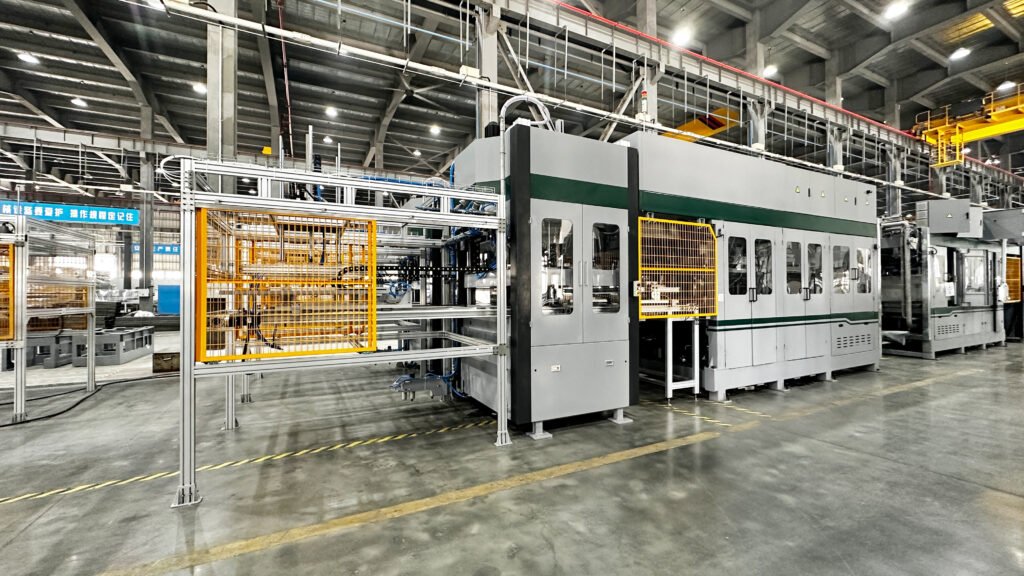
What is an automatic fiber tableware forming machine?
An automatic fiber tableware forming machine — also referred to as a pulp molded tableware machine, molded fiber tableware machine, or bagasse tableware machine — is the central piece of equipment in a fiber-based disposable tableware production line. It takes a prepared pulp slurry and forms it into precise tableware shapes using vacuum suction molds, then immediately hot-presses, trims, and stacks the finished products in a single continuous automated process.
The key distinction between automatic and semi-automatic systems is the degree of integration. On a semi-automatic line, products are transferred manually between forming, drying, pressing, and trimming stations. A fully automatic machine completes all of these stages — forming, hot pressing, trimming, and stacking — within one integrated unit, controlled by a PLC (programmable logic controller) or servo motor system, with robotic arms or motorized transfer mechanisms moving products between stations without human intervention.
The result is a machine capable of producing 3,000 to over 10,000 pieces of tableware per hour, with consistent dimensional accuracy, smooth surface finish, and low per-unit labor cost — characteristics that make automatic systems the preferred choice for large-scale food service supply chains, contract manufacturers, and export-oriented producers.
How does an automatic fiber tableware forming machine work?
The production process inside a fully automatic fiber tableware forming machine follows five integrated stages. Understanding each stage matters for evaluating machine quality, energy efficiency, and the final product’s performance characteristics.
Stage 1 — Pulp preparation
Before reaching the forming machine, raw fiber material must be converted into a uniform slurry. Sugarcane bagasse pulp boards, recycled paper, bamboo pulp, or wheat straw are fed into a hydrapulper with water. The mixture is broken down into a cotton-like fiber slurry, then processed through a deflaker and refiner to optimize fiber length and remove contaminants. Chemical additives — such as waterproofing agents, oil-resistance coatings, or wet-strength enhancers — are blended in at a proportioning tank based on the end-product requirements. The finished slurry, typically at 0.5–1.5% fiber concentration, is pumped to a slurry supply tank ready for the forming machine.
Stage 2 — Vacuum forming
The slurry is pumped into the forming tank of the machine. A mesh mold — precisely machined to the shape of the target tableware item — is submerged in the slurry tank, and vacuum pressure draws fibers uniformly onto the mold surface. The wet fiber blank is then lifted out of the tank. The vacuum system is critical here: consistent vacuum pressure determines uniform product wall thickness, which directly affects structural strength and surface quality. Modern automatic machines use servo-controlled vacuum systems with real-time pressure monitoring to maintain consistency across thousands of cycles per hour.
Stage 3 — Hot pressing
The wet fiber blank is transferred — by robotic arm or motorized screen frame — to a hot press station. Upper and lower heated molds compress the product simultaneously, removing moisture rapidly and imprinting the final shape with precision. Hot pressing produces the smooth, flat surface finish that distinguishes premium fiber tableware from rough-textured egg-tray-style products. It also increases dimensional accuracy and structural rigidity. Dual hot press configurations — where two press stations operate alternately — increase throughput without sacrificing dwell time, allowing output rates of 5,000+ pieces per hour for flat-profile items such as plates.
Stage 4 — Trimming
After hot pressing, products are automatically transferred to a trimming station. Hydraulic or hydro-pneumatic trimming dies cut away excess fiber from edges to achieve clean, consistent dimensions. Advanced machines use patented free-punching and free-trimming technology, which eliminates a dedicated trimming step entirely by integrating edge control into the forming and pressing molds — reducing production cost by approximately 15% compared to conventional semi-automatic trimming workflows.
Stage 5 — Stacking, counting, and packaging
Finished products are automatically stacked, counted, and prepared for downstream packaging. On high-end production lines, intelligent counting systems and robotic stacking arms handle output with no manual intervention. Some systems integrate inline quality inspection using machine vision cameras to detect surface defects, dimensional deviations, or contamination before products reach the packaging stage.
What products can an automatic fiber tableware forming machine produce?
Automatic fiber tableware forming machines are designed specifically for disposable food service products. The machine configuration — particularly mold design and hot press platen size — determines which product categories are possible.
- Plates and dishes: Round, square, and oval plates from side-plate size (15cm) to large serving platters. The highest-volume product category, suited to both food service supply chains and retail.
- Bowls and soup containers: Deep-draw bowl profiles require machines with greater mold depth capability and longer hot press dwell times. Biodegradable coatings applied during pressing enable oil and liquid resistance for hot soups and sauced dishes.
- Clamshell food boxes: Hinged two-part containers for takeaway meals, burgers, and bakery items. One of the fastest-growing product categories driven by the global food delivery market.
- Food trays and compartment trays: Multi-compartment meal trays for airline catering, school meals, hospital food service, and event catering. Require large-platen forming machines (1,000mm × 950mm and above).
- Cups and cup lids: Fiber cups require specialized deep-cavity forming technology. Advanced machines such as those with SD-P09 configurations can produce pulp cups and matching lids in a single production run.
- Cake trays and bakery packaging: Shallow-profile trays with decorative surface texture, used in retail bakery and patisserie packaging.
Products can be made from a range of raw materials. Sugarcane bagasse is the dominant input globally, particularly in India, Southeast Asia, and Latin America, where it is available as a low-cost agricultural by-product of sugar production. Bamboo pulp produces higher-strength products. Recycled paper and cardboard remain the most cost-effective raw material for standard applications.
What types of automatic fiber tableware forming machines are available?
Machines are differentiated by output capacity, automation level, forming technology, and platen size. Choosing the right configuration depends on target production volume, product mix, available capital, and raw material inputs.
- Single hot press automatic machines: Entry-level fully automatic configuration with one forming station and one hot press station. Typical output: 2,000–4,000 pieces per hour for plates and shallow-profile items. Capital cost: $150,000–$300,000. Suitable for small to mid-sized producers starting automated production.
- Dual hot press automatic machines: Two hot press stations operating in alternating cycles, doubling throughput versus single press systems. Typical output: 4,000–6,000 pieces per hour. Capital cost: $300,000–$600,000. The most common configuration for mid-scale commercial operations.
- Rotary / multi-station automatic machines: Multiple forming and pressing stations on a rotary or linear shuttle system. Output exceeds 8,000–10,000+ pieces per hour. Required for large-scale export-oriented production or major food service supply contracts. Capital cost: $600,000–$2,000,000+.
- Servo robotic arm machines: Six-axis industrial robotic arms handle all product transfers between stations. Offer the highest precision, flexibility for complex shapes (including negative-angle geometries such as cup lids), and fastest changeover times between mold configurations. Preferred for premium tableware lines and products requiring tight dimensional tolerances.
- Integrated trimming-free machines: Incorporate patented mold designs that eliminate the separate trimming step, reducing energy, time, and per-unit cost. Increasingly common in new installations as the technology matures.
Why is demand for automatic fiber tableware forming machines growing?
The growth in demand for automatic fiber tableware forming machines is driven by intersecting regulatory, corporate, and market forces that are simultaneously expanding the addressable market and accelerating the transition away from plastic alternatives.
Regulatory pressure on single-use plastics
The European Union’s Single-Use Plastics Directive bans polystyrene foam food containers across all member states. China has implemented a phased national ban on non-degradable single-use plastic tableware, with major cities fully enforcing restrictions since 2021. India, Bangladesh, Rwanda, and over 60 other countries have enacted various levels of plastic restriction affecting food service products. Each regulation creates a direct, time-bound requirement for food service operators and packaging manufacturers to source fiber-based alternatives — and by extension, for producers to invest in the machines that make them.
Food service market growth
The global food delivery market — one of the primary drivers of disposable tableware demand — continues to expand rapidly. Food delivery platforms in Asia, the Middle East, and Latin America are adding millions of new customers annually, each order generating demand for takeaway containers, clamshells, and trays. Automatic fiber tableware forming machines are the only production technology currently capable of meeting this demand at scale with biodegradable materials.
Market size and growth trajectory
The molded fiber tableware market was valued at approximately $4.5 billion in 2025 and is projected to grow at a compound annual growth rate (CAGR) of 5.3% through 2035, reaching significant scale as plastic alternatives become the regulatory default across major markets (GMI Research, 2026). The broader eco-friendly molded fiber tableware segment is forecast to reach $9 billion by 2033, growing at 7% CAGR from 2025 (Data Insights Market, 2025). Transfer-molded products — the primary output of automatic fiber forming machines — account for 43.3% of total market volume in 2025.
Premium product expansion
A significant trend since 2021 has been the emergence of premium molded fiber tableware targeting hospitality, catering services for events, and upscale food service providers. These customers require smooth surface finish, consistent dimensions, and aesthetic presentation that matches or exceeds plastic alternatives — requirements that only automatic hot-press forming machines can meet at scale. Premium fiber tableware commands substantially higher margins than commodity egg trays or standard packaging, making the investment in automatic equipment increasingly justifiable even for mid-sized producers.
Biodegradable barrier coating advances
Until recently, fiber tableware’s weakness was moisture and oil resistance — a critical limitation for hot food applications. Water-based and bio-based biodegradable barrier coatings, which can be applied inline during the hot pressing stage, have largely resolved this constraint. Products made on modern automatic forming machines can now hold hot liquids, function in microwaves up to 120°C, and resist oil contamination — expanding the addressable application range and addressing the primary objection from food service operators considering a switch from plastic.
What should investors and sustainability professionals know before buying or funding a fiber tableware forming machine?
The economic case for automatic fiber tableware forming machines is strong, but realizing returns requires understanding the full production system, not just the forming machine itself.
Total line investment, not just the forming machine
The forming machine is the most visible component of a production line, but it is one of four critical systems. Stock preparation (pulping, refining, proportioning) and the vacuum system must be sized to match forming machine output — a mismatch creates bottlenecks that prevent the line from reaching rated capacity. Buyers who purchase only the forming machine and underestimate support systems consistently underperform on output targets. A complete turnkey automatic fiber tableware line — from pulping through packaging — typically costs $400,000 to $2.5 million depending on output scale and automation level.
Raw material sourcing strategy
Production economics are substantially affected by raw material cost and proximity. In sugarcane-producing regions, bagasse is available at $30–80 per ton as a sugar mill by-product. In markets without local bagasse supply, importing pulp boards adds $80–150 per ton in logistics cost. Building the stock preparation system to handle multiple fiber types — bagasse, recycled paper, bamboo — provides supply chain resilience and the ability to optimize input costs as market prices fluctuate.
Key investment opportunities
- Strong and binding regulatory tailwind across the EU, China, India, and 60+ additional markets
- Rapidly expanding food delivery market providing sustained disposable tableware demand
- Premium segment (smooth-surface thermoformed tableware) commanding 40–60% higher margins than commodity packaging
- Low and stable raw material costs in sugarcane and bamboo-producing regions
- Automation reducing per-unit labor cost as output scales
- Localized production trend reducing dependence on imported packaging and lowering logistics carbon footprint
Risks to monitor
- High upfront capital requirement ($150,000 to $2M+ depending on automation level)
- Water-intensive production process requiring wastewater treatment infrastructure
- Mold change costs for product diversification ($5,000–$20,000 per mold set)
- Competition from bioplastic alternatives (PLA, PBAT) in some food service segments
- Energy consumption of hot pressing at scale, partially offset by heat recovery systems
Frequently asked questions
What is an automatic fiber tableware forming machine in simple terms?
An automatic fiber tableware forming machine is industrial equipment that converts recycled paper, sugarcane bagasse, or bamboo — mixed with water to form a slurry — into biodegradable disposable tableware such as plates, bowls, food boxes, and trays. The entire process — forming, hot pressing, trimming, and stacking — is completed automatically within a single integrated machine.
How much does an automatic fiber tableware forming machine cost?
Prices range from $150,000–$300,000 for entry-level fully automatic single hot press systems to $300,000–$600,000 for dual hot press configurations, and $600,000–$2,000,000+ for high-output rotary or servo robotic systems. A complete production line including pulping, vacuum, and packaging systems adds 30–60% to the forming machine cost.
What raw materials does a fiber tableware forming machine use?
The most common raw material is sugarcane bagasse pulp board, which accounts for the majority of production in Asia, India, and Latin America. Other materials include bamboo pulp (higher strength), recycled paper and cardboard, wheat straw, and wood pulp. The choice of fiber affects product strength, surface smoothness, and raw material cost.
How many pieces per hour can an automatic fiber tableware forming machine produce?
Single hot press automatic machines produce approximately 2,000–4,000 pieces per hour. Dual hot press systems reach 4,000–6,000 pieces per hour. High-output rotary or multi-station configurations exceed 8,000–10,000 pieces per hour for flat-profile items such as plates. Deep-draw products such as bowls and cups have lower throughput rates due to longer forming and pressing cycles.
Is fiber tableware made on these machines truly compostable?
Yes. Standard molded fiber tableware is biodegradable and industrially compostable. Food-grade biodegradable barrier coatings — applied inline during hot pressing — add water and oil resistance without compromising compostability. Products can typically be certified to EN 13432 (European compostability standard) or ASTM D6400 (US standard) depending on the coating materials used.
What is the difference between automatic and semi-automatic fiber tableware machines?
Semi-automatic machines require manual handling between production stages — typically between forming and drying or between pressing and trimming. Automatic machines complete all stages within one integrated unit with no manual product transfer. Automatic machines deliver higher output, lower per-unit labor cost, and more consistent product quality, but require greater upfront capital investment.
Which industries use fiber tableware produced by these machines?
The primary end markets are food delivery and takeaway packaging, restaurant and food service disposables, airline and institutional catering (hospitals, schools, event catering), retail bakery and patisserie packaging, and outdoor events. The food service sector accounts for the largest share of demand, driven by the global growth of food delivery platforms and regulatory restrictions on plastic alternatives.
What certifications should a fiber tableware forming machine produce products compliant with?
Products made for food service applications should comply with food-contact safety standards relevant to the target market: FDA regulations (USA), EU Regulation 10/2011 (Europe), and GB 4806 (China). Compostability certifications include EN 13432 (Europe), ASTM D6400 (USA), and BPI certification for the North American market. Oil and water resistance coatings must also comply with applicable food-contact additive regulations in each market.
 English
  Thai
Thai  Russian
  Vietnamese