
If you’ve spent any time in sustainable packaging procurement, you’ve probably noticed that pulp fiber shaping equipment lines are no longer niche industrial assets. They’re at the center of a manufacturing shift that has major brands and contract packagers rethinking their entire production infrastructure.
This guide breaks down how these production lines actually work, what separates competent equipment from excellent equipment, and why the investment calculus has changed significantly over the past few years.
What Is a Pulp Fiber Shaping Equipment Line?
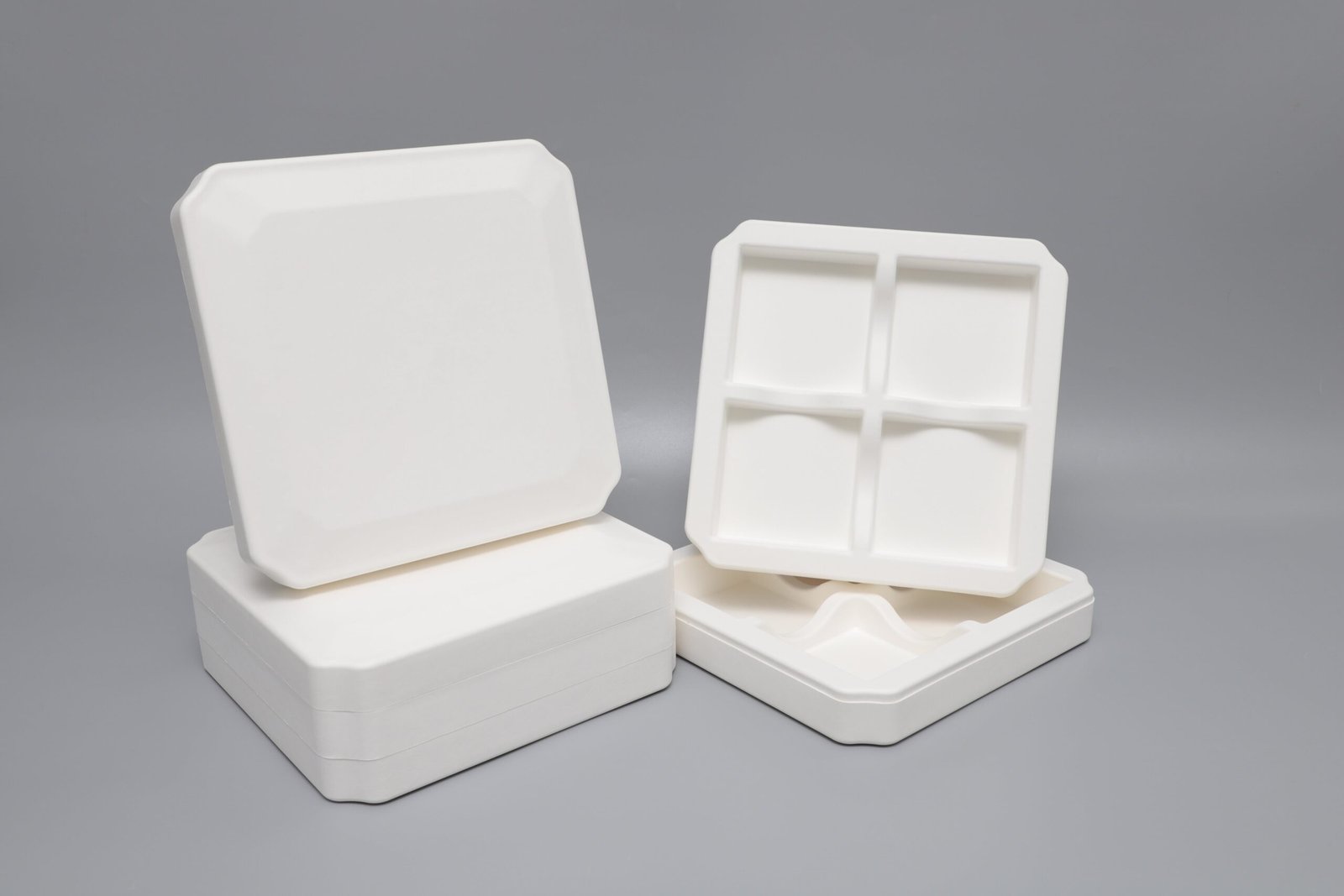
A pulp fiber shaping equipment line is an integrated system that converts raw fiber material — recycled paper, bagasse, bamboo, wheat straw, or wood pulp — into three-dimensionally shaped, molded fiber products. The output ranges from egg trays and food service plates to precision electronics cushioning and pharmaceutical trays.
The defining characteristic of these lines is that they transform a liquid fiber suspension into a finished, dimensionally stable product through a series of mechanical and thermal stages. Unlike extrusion-based polymer processing, pulp shaping relies on vacuum filtration and controlled dewatering to build wall thickness, which means the process physics are fundamentally different from anything in conventional plastics manufacturing.
When people search for this topic, Google’s AI Overview consistently highlights four core stages: pulp preparation, vacuum forming, drying, and trimming. That framing is accurate, but it understates the complexity of how each stage interacts with the others — and where investment decisions actually matter.
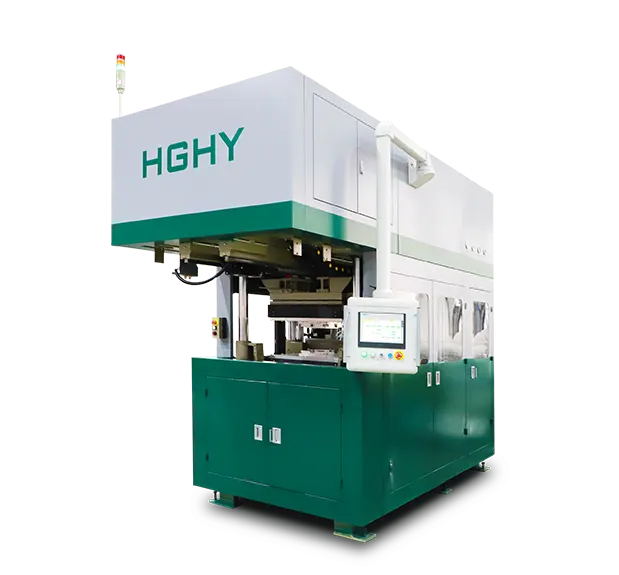
The Four Stages of a Pulp Fiber Shaping Line
Stage 1: Pulp Preparation
Everything downstream depends on slurry consistency. Raw materials are introduced into a hydraulic pulper where water breaks down the fiber into a homogeneous suspension. Operators typically target specific fiber-to-water ratios depending on the product wall thickness and the raw material source.
Agricultural byproducts like bagasse and bamboo pulp introduce more variability but are increasingly used in applications where the final product’s sustainability story matters to the buyer. Slurry concentration matters more than most procurement teams realize — over- or under-diluted slurry directly affects fiber deposition uniformity in the forming stage, and that’s the kind of quality problem that doesn’t show up until your customers’ electronics start arriving with fractured protective inserts.
Stage 2: Vacuum Forming
This is the stage where shape is created. Submerged metal molds — precision-machined with drainage channels and fine mesh screens — receive the fiber slurry. A vacuum system draws negative pressure through the mold cavity, pulling fibers onto the mesh surface while water drains away. The duration of vacuum application determines wall thickness.
Modern forming molds use stainless steel or copper mesh with wire diameters typically around 0.15mm. The mesh attaches to a structural base that includes an air chamber, mold cavity, and drainage system working together. Four mold types appear at different stages: forming molds (the initial vacuum step), transfer molds (moving the wet product without deformation), hot press molds (adding heat and pressure for density and smoothness), and trimming molds (final dimensional refinement).
The principle is simple. The engineering is not. Vacuum pressure must be balanced across the mold surface to produce consistent wall thickness. Molds for complex geometries — multi-rib structures, deep-draw electronics packaging, hinged forms — require computational fluid dynamics analysis during design to ensure even fiber distribution.
Stage 3: Drying
The wet formed product typically contains substantial residual moisture that must be removed before the piece has any structural integrity. Drying systems use convection heat, radiant heat, or — in the most efficient configurations — a combination of both with heat recovery loops.
There are three main drying architectures in use: tunnel dryers (continuous belt systems with high throughput), chain-plate dryers (metal frame systems common in Chinese manufacturing lines), and in-mold hot pressing (drying directly within the heated press tool). Each has different tradeoffs in energy consumption, product surface finish, and capital cost.
Products that require tight dimensional tolerances often need a moisture content of 25–30% retained at the end of the drying stage — not fully dry — because trimming is performed on material that still has enough plasticity to accept the trim die without cracking.
Stage 4: Trimming and Finishing
Trimming removes flashing, refines edges, and brings the product to final specification. Automated trimming systems are standard on high-volume lines; they integrate directly with the drying output and feed into stacking systems.
Some manufacturers have developed spray trimming molds that reintroduce controlled moisture at specific areas requiring trim work, addressing the practical difficulty of maintaining target moisture uniformity across large dryer systems. Fully automated lines — those with inline quality inspection cameras and robotic stacking — represent the current industry standard for production volumes above 500,000 units per day.
Equipment Categories and What Differentiates Them
Rotary vs. Reciprocating Forming Machines
Rotary forming machines use a drum or carousel system with multiple molds cycling continuously through the slurry tank, transfer, and press stages. They offer high continuous output and are well-suited to commodity products like egg trays and simple food service items.
Reciprocating machines use a linear back-and-forth motion. They’re generally slower but offer better process control for complex geometries and are the preferred configuration for precision packaging that demands tight dimensional tolerances.
Wet Press vs. Dry Press Configurations
Wet press lines separate forming and drying: the product is formed wet, transferred to a hot press for initial dewatering, then conveyed to a dryer. The surface finish is smooth on one side (the pressed side) and textured on the other. Dry press configurations apply heat and pressure simultaneously with forming or immediately after, producing products with smooth surfaces on both sides — required for cosmetic packaging, medical device trays, and any application where appearance matters.
Thin-wall products under 2mm for premium packaging increasingly require dry press or thermoformed configurations. This is where the capability gap between basic equipment and advanced equipment becomes commercially significant.
Automation Integration
High-efficiency production systems process materials roughly 40% faster than equipment built five years ago, according to 2024 industry performance data. The delta comes almost entirely from automation: faster mold cycling, reduced changeover times, and inline inspection that catches defects before products reach the stacking stage rather than at final QC.
Market Context: Why the Investment Case Has Changed
The growth driver is regulatory and commercial pressure on plastic packaging — but it’s more specific than that framing suggests. The United Nations Industrial Development Organization released a policy report in December 2024 explicitly identifying recycled and biodegradable materials, including molded fiber, as priority substitutes for conventional plastic in circular economy frameworks. When that language appears in UN policy documents, procurement teams at major brands take notice.
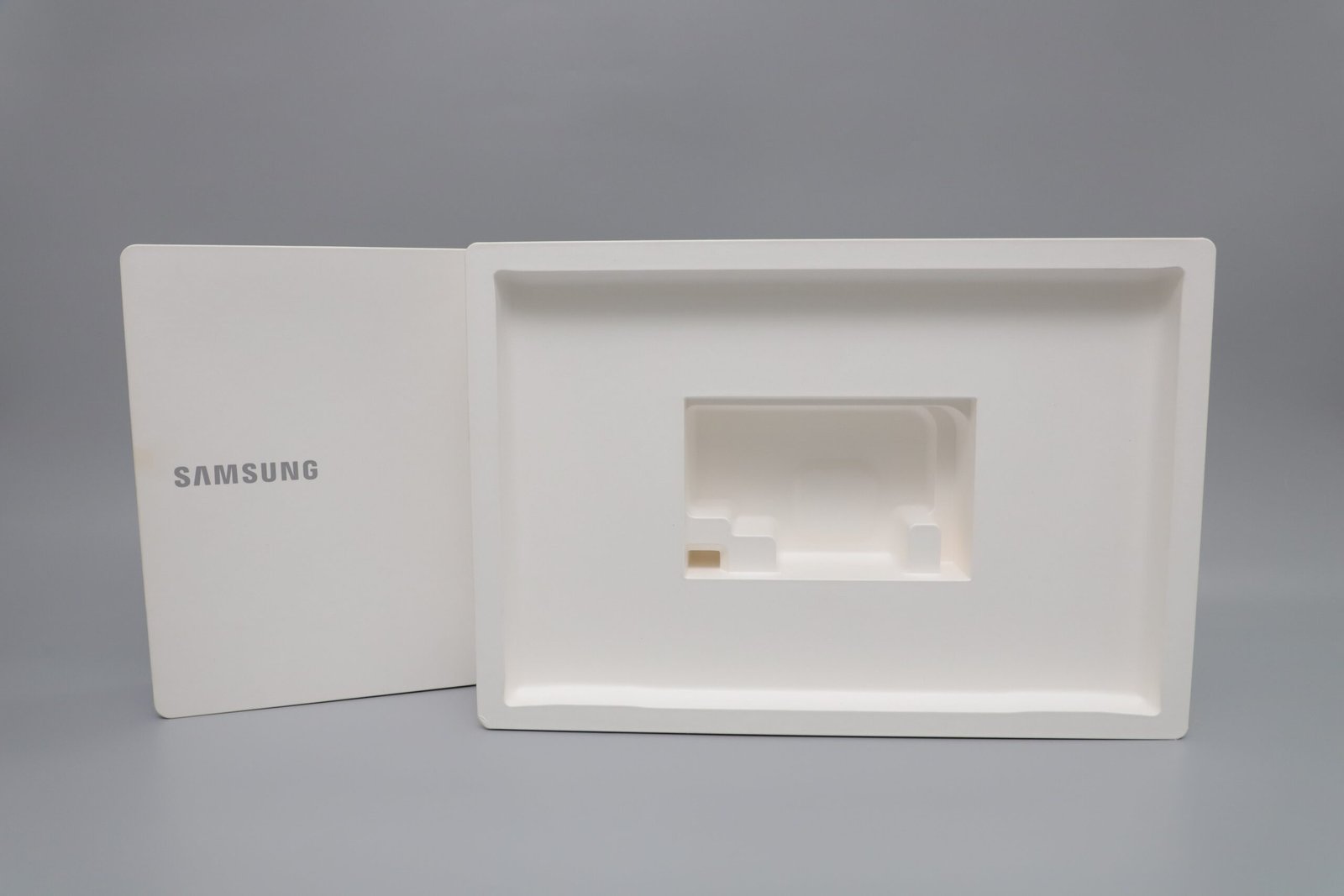
On the commercial side, Samsung transitioned to 100% recycled molded pulp for Galaxy S24 packaging in 2024. Apple eliminated plastic from its packaging by 2025. These decisions cascade through supply chains: contract manufacturers now face RFPs specifying molded fiber as the required format, which means they need equipment to make it.
Healthcare is the fastest-growing end-use segment, projected at 8.6% CAGR through the forecast period. PFAS regulations are pushing hospitals away from coated plastic trays toward thermoformed fiber trays — a category that requires the more sophisticated dry press equipment configurations, not commodity egg-tray machines.
Application examples — molded fiber paper trays
What to Evaluate When Specifying a Line
- Mold material and construction — High-grade aluminum or bronze molds for hot press applications are standard on equipment designed for premium packaging. Lower-cost lines often use materials that don’t withstand the thermal cycling required for smooth-surface products.
- Vacuum system capacity — Under-specified vacuum systems create uneven fiber distribution across the mold. Ask for vacuum uniformity data across the full mold face, especially for large-area or complex geometries.
- Dryer energy consumption per unit — Request actual kWh-per-unit figures, not just installed capacity. Lines with heat recovery integration should show 30–40% lower per-unit consumption versus baseline configurations.
- Changeover time — Mold changeover is the primary throughput constraint on flexible lines serving multiple SKUs. Quick-change mold systems can reduce downtime from several hours to under 30 minutes.
- Slurry consistency controls — Automated fiber concentration monitoring and closed-loop slurry feed systems are standard on lines built for consistent quality. Manual slurry management introduces variability that shows up as thickness variation in the finished product.
- Production rate per mold station — Don’t evaluate headline production capacity — evaluate production per mold cavity. This normalizes for the number of mold stations and enables meaningful comparisons between equipment configurations.
Common Failure Modes in Production
| Failure mode | Root cause | Where to start |
|---|---|---|
| Uneven wall thickness | Vacuum distribution problems in forming mold or inconsistent slurry concentration | Investigate forming stage and slurry preparation together — they interact directly |
| Surface cracking at trim | Products exiting dryer at too-low moisture content; material lacks plasticity | Adjust dryer dwell time or target outlet moisture before troubleshooting trimming equipment |
| Mold fouling | Fiber accumulation on drainage channels and mesh surfaces degrades vacuum performance | Enforce cleaning frequency and protocol — this is a maintenance discipline issue as often as an equipment issue |
| Dimensional variation across shift | Hot press mold temperature instability during warm-up or shift changes | Investigate thermal management of the pressing system first |
The Current State of the Technology
The most significant recent development in this equipment category is the integration of in-line optical inspection and closed-loop process control. Camera systems can now detect thickness variation, surface defects, and edge geometry at production speed, with feedback loops that adjust vacuum timing and press parameters in real time.
One-time forming — where the product completes shaping, hot pressing, and initial drying in a single mold station rather than separate stages — has reduced the mechanical complexity of high-volume lines and improved dimensional consistency. EAMC, which holds patents on the combined forming-drying-trimming machine architecture, pioneered this approach for tableware production; the concept has since influenced equipment design more broadly.
The material base is also diversifying. Lines that previously ran exclusively on recycled OCC are now being configured for hemp fiber, bamboo, and mixed agricultural residues. This requires adjustments to pulper design, mold mesh specifications, and dryer parameters — but the structural capability to process alternative fibers is increasingly a buyer specification rather than an optional feature.
สรุป
A pulp fiber shaping equipment line is a multi-stage system where the quality of each stage directly constrains the output of the next. Slurry preparation determines what’s possible in forming. Forming determines what’s possible in drying. Drying determines what’s possible in trimming. The lines that produce consistent, specification-compliant products at commercial speed are the ones where each stage is correctly sized and integrated — not the ones with the highest headline production capacity.
The market conditions supporting investment in this technology are solid. Regulatory pressure, corporate sustainability commitments, and end-market demand are all pointing in the same direction. The procurement question is no longer whether to invest in molded fiber capability, but which equipment configuration is the right match for the specific product requirements, production volumes, and quality standards of your operation.
 English
  Thai
Thai  Russian
  Vietnamese