
Four years ago, biodegradable tableware in India was mostly a story about a ban. Today it’s becoming a story about factories.
The regulation part has largely been settled. What’s still open is who actually builds the production capacity to serve it, and what that capacity looks like by 2030. If you’re thinking about manufacturing in this space, here’s my read on where things are heading.

The foundation: policy that isn’t going away
India has enforced a nationwide prohibition since July 1, 2022 on the manufacture, sale and use of specific single-use plastic items, including plates, cups and cutlery. That alone created a gap in the market. What has changed since then is enforcement and paperwork.
By March 2026, India had over 60,000 registered producers, importers and brand owners under the EPR system, along with roughly 3,000 registered plastic waste processors. In plain terms, big buyers now have compliance obligations of their own, and they pass those requirements down to their suppliers. A tableware maker who can’t show where their material comes from, or that it meets standards, will find it harder to get through procurement.
There’s also a tightening on the “compostable plastic” side. The 2024 amendment to the Plastic Waste Management Rules requires compostable plastic packaging to meet IS/ISO 17088:2021 and obtain CPCB certification before it can be marketed. That raises the bar for bioplastic-based products, and it quietly helps plant-fiber and molded pulp products, which don’t carry the same certification complications.
State governments are also getting involved. Uttar Pradesh’s Bioplastic Industry Policy 2024 offers financial support for biodegradable alternatives, including a 50% capital subsidy for eligible anchor units. Expect more states to compete for this kind of investment between now and 2030.
The demand side: food delivery does the heavy lifting
Regulation creates the opening. Volume comes from how India eats.
Food delivery, quick service restaurants, cloud kitchens and catering keep growing, and every one of them runs on disposables. One industry voice put it bluntly: disposable cutlery demand in India is unavoidable because of the size of the food delivery ecosystem. Meanwhile, the wider Indian tableware market was valued at about USD 5.29 billion in 2024 and is expected to nearly double by 2032.
A quick word of caution on numbers. Market research reports on this segment disagree wildly. One estimate puts India’s biodegradable tableware and packaging market at about USD 890 million in 2026, while another projects USD 2.82 billion for 2026, mostly because they define the category differently. Don’t build a business plan around any single headline figure. Do notice that every credible source points the same way.
What will separate winners from the rest by 2030
Here’s where I think the next few years get interesting. When a market is young, almost anyone with a machine and a customer can survive. By 2030, I expect the field to sort itself out, based on a few things.
1. Consistency at scale. Large buyers will want a million plates that look identical, not a good sample and a variable shipment. This favors automated, repeatable production over hand-operated setups.
2. Cost per piece. As more capacity comes online, prices will come under pressure. The manufacturers who survive will be the ones who have squeezed labor, energy, water and scrap down to the lowest sensible level.
3. Raw material security. Bagasse, bamboo fiber, wheat straw and recycled pulp each have different supply patterns. North and West India accounted for around 81% of bagasse tableware production volume in 2023, which hints at how regional supply and clustering will matter. Factories close to dependable fiber sources will have a quiet advantage.
4. Compliance as a selling point. Documentation, certification and traceability will move from “nice to have” to “required to be considered.” Smaller operators who ignore this will lose access to the biggest accounts.
5. Export readiness. As Indian factories improve, some will look abroad. Export buyers care about food-contact safety, repeatable quality and clean processes, all of which are easier to demonstrate on a controlled, automated line.
Where automation fits in
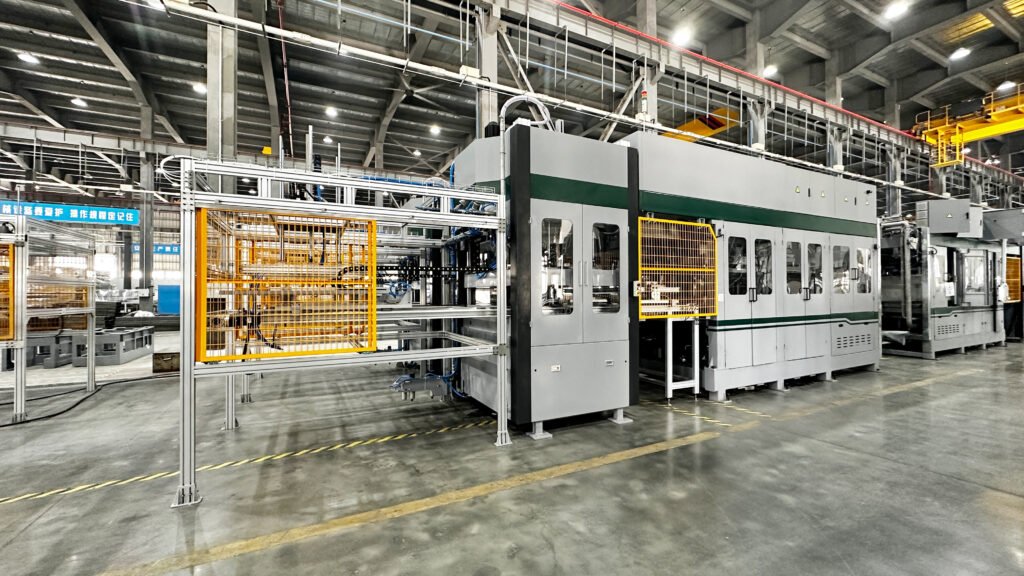
This is the part where I’d gently push back on the “start small and see” instinct. Most of the factors above point toward automation, and not because it’s trendy. A well-run automatic line gives you steadier quality, a smaller labor footprint, and a more predictable cost structure, which are exactly the things that matter when the market gets crowded.
For molded fiber specifically, a machine like the Fully Automatic Tableware Machine is the kind of equipment worth putting on your shortlist. HGHY’s published line details mention roughly 3 to 4 operators per shift, energy-saving design, water recycling in the process, and supplier support covering installation, test running and training, backed by a one-year warranty. None of that is a guarantee of profit, and a fully automatic line still needs proper workshop space, adequate power and a reliable pulp supply. But it’s the kind of setup that suits a factory planning to still be competitive in 2030, not just open in 2026.
A realistic view of the risks
It wouldn’t be fair to paint only the bright side. A few things could slow things down:
- Uneven enforcement. Rules on paper don’t always mean rules in practice, and local enforcement varies a lot.
- Price sensitivity. Many buyers, especially street vendors and small eateries, will still choose the cheapest option available.
- Rising competition. Easy demand attracts new entrants, and margins will thin out.
- Policy shifts. Subsidies, GST treatment and certification rules can change.
None of these kill the opportunity. They just mean the manufacturers who plan carefully will outlast those who rush in.
So, what does 2030 look like?
My honest guess: fewer, bigger, better-run factories. Cleaner supply chains. Buyers who ask for documentation before they ask for a price. And a clear gap between producers who invested in consistency early and those who tried to stretch a small setup too far.
The opportunity in Indian biodegradable tableware is real, and it isn’t going to vanish. But it will reward the people who treat it as a manufacturing business, not a quick trade.
Planning a production line for the next five years? Talk to HGHY’s team about which fully automatic tableware solution fits your target volume, raw material and budget.
 English
 Thai
 Russian
 Vietnamese