
Kenya’s stance on plastic pollution has been among the strictest on the continent since the 2017 ban on plastic carrier bags, followed by tighter restrictions on single-use plastics in protected areas such as national parks, forests, and beaches. This policy direction has not slowed down — it has pushed manufacturers, hotels, airlines, and food vendors to look for durable, biodegradable alternatives that can replace plastic plates, bowls, cups, clamshells, and trays. Molded fiber tableware, made from sugarcane bagasse, waste paper, wheat straw, or bamboo pulp, has become one of the most practical answers to that demand, and the machinery that produces it is quickly becoming one of the more attractive manufacturing investments in East Africa.
A Policy Environment Built for Green Manufacturing
Kenya’s government has paired its plastic restrictions with real incentives for businesses willing to invest in eco-friendly production. Through the Kenya Investment Authority (KenInvest), investors in manufacturing — particularly those producing goods that reduce environmental impact — can access support with licensing, land acquisition, and utility connections, along with guidance on available incentive schemes.
Manufacturers operating within Kenya’s Special Economic Zones (SEZs) and Export Processing Zones (EPZs) benefit from reduced corporate tax rates for an initial period, exemption from VAT and import duty on plant, machinery, and raw materials, and streamlined customs procedures for both importing equipment and exporting finished goods to the East African Community (EAC) and COMESA markets. The Finance Act has also extended capital allowance benefits for investment in machinery used in manufacturing, allowing businesses to write off equipment costs against taxable income at an accelerated rate — a direct benefit for anyone importing a molded fiber production line.
For a molded fiber tableware operation, this combination matters in two ways. First, it lowers the effective cost of importing machinery, which is typically the largest single expense in setting up production. Second, it improves the economics of scaling up, since a business can reinvest tax savings into additional molds, automation upgrades, or a second production line without the same capital burden it would face elsewhere in the region.
Why Molded Fiber Tableware Fits Kenya’s Raw Material Base
One reason this industry is gaining traction locally is that Kenya already produces the raw materials in large volumes. The sugar belt around Mumias, Kisumu, and Muhoroni generates substantial quantities of bagasse as a byproduct of sugar milling, much of which is currently underused or burned as low-value fuel. Wheat straw from the Rift Valley, banana fiber from central Kenya, and recovered waste paper from urban centers add further options. A molded fiber tableware line effectively turns agricultural residue into a finished, exportable product, which aligns with both the government’s circular economy goals and the interests of agribusinesses looking to add value to their waste streams.
What the Equipment Actually Does
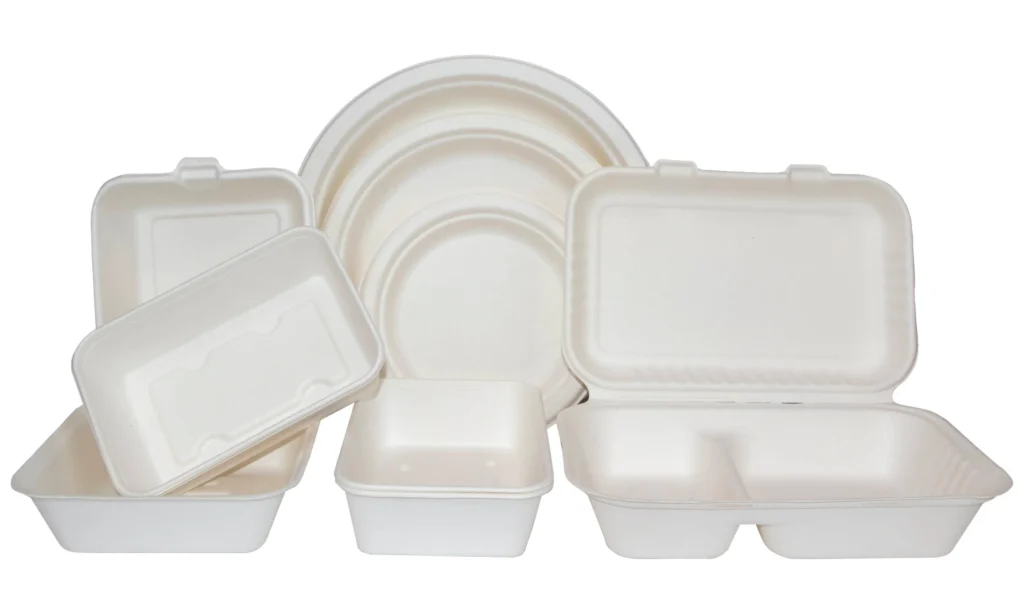
А molded fiber tableware production line converts raw fiber into finished plates, bowls, clamshell containers, cup trays, or food takeaway boxes through a sequence of mechanical and thermal processes:
Pulping system — Raw material (bagasse, waste paper, or straw) is broken down with water into a fine pulp slurry in a hydrapulper, with impurities screened out to ensure consistent fiber quality.
Forming station — The pulp slurry is drawn onto perforated molds under vacuum, where water is extracted and the fiber takes the shape of the mold. Rotary or reciprocating forming machines are both common, with rotary types generally suited to higher-volume operations.
Transfer and hot pressing — Formed products are transferred to a hot-pressing stage, where heated molds compress and dry the product simultaneously, giving it the smooth, rigid, food-safe finish customers expect.
Trimming and finishing — Edges are trimmed automatically or semi-automatically, and products can be treated with water-resistant or oil-resistant coatings depending on the intended use — takeaway food packaging typically requires this step.
Stacking and packaging — Finished tableware is counted, stacked, and packed, ready for distribution.
Production lines are available across a wide range of capacities, from smaller manual or semi-automatic setups suited to a first-time investor testing the market, up to fully automatic rotary lines capable of producing tens of thousands of pieces per day for buyers supplying supermarkets, hotel chains, or export contracts. Mold configurations can be customized for plates, bowls, egg trays, fruit trays, or clamshell food containers, and many suppliers offer combination molds so a single line can switch between multiple product types.

Matching Equipment to the Kenyan Market
For an investor evaluating this opportunity, the choice of machine should be guided by realistic assessment of buyers rather than by the largest available line. Hotels, restaurants, and catering services in Nairobi, Mombasa, and Kisumu are steady buyers of plates and bowls. Fresh produce exporters and local supermarkets need egg trays and fruit trays in large volumes. Food delivery and takeaway businesses, a fast-growing segment in urban Kenya, are the primary market for clamshell containers and lunch boxes.
A phased approach works well in practice: starting with a semi-automatic line focused on one or two product types, validating demand and refining product quality, then reinvesting profits — supported by the capital allowance benefits mentioned earlier — into a second line or an upgrade to full automation. This reduces initial capital exposure while still positioning the business to scale once market relationships are established.
Cost and Return Considerations
Machinery pricing depends heavily on configuration — mold count, automation level, and daily output capacity are the main variables. Semi-automatic lines represent the lower end of the investment range and are commonly chosen by first-time operators, while fully automatic rotary lines with multiple mold stations sit at the higher end and are typically chosen by operators with confirmed bulk orders or export contracts already in place.
Running costs are dominated by raw material, water, electricity, and labor, and because bagasse and waste paper are low-cost or even byproduct materials in Kenya, the margin structure tends to be favorable once a line is running at a reasonable utilization rate. Payback periods vary by scale and market access, but operators supplying stable institutional buyers — hotels, catering companies, supermarket chains — tend to reach consistent profitability faster than those relying solely on open retail sales.
What to Look for in a Supplier
Given that most molded fiber production lines used in Kenya are imported, the choice of equipment supplier matters as much as the choice of machine. Investors should look for suppliers who provide:
- Installation and commissioning support, including technicians who can set up the line on-site rather than shipping equipment with instructions only
- Operator training covering pulp preparation, mold maintenance, and troubleshooting
- Spare parts availability and clear lead times, since downtime on a single production line directly affects output
- Flexibility on mold design, so the line can be adapted to new product shapes as market demand shifts
- A track record of shipping equipment that clears Kenyan customs smoothly, particularly for buyers hoping to benefit from EPZ or SEZ duty exemptions
A Practical Entry Point Into Green Manufacturing
Kenya’s plastic policy is not a temporary campaign — it is a long-term regulatory direction backed by investment incentives designed to make compliant alternatives commercially viable. Molded fiber tableware sits directly at the intersection of that policy and Kenya’s agricultural raw material base, giving investors a product with built-in regulatory tailwinds, a domestic material supply chain, and export potential across the EAC region.
For anyone evaluating manufacturing investments in Kenya’s green economy, a molded fiber tableware production line offers a relatively low barrier to entry, a scalable equipment path from semi-automatic to fully automatic, and a market that is only expected to grow as plastic alternatives become standard practice across East Africa’s hospitality and retail sectors.
 English
  Thai
Thai  Russian
  Vietnamese